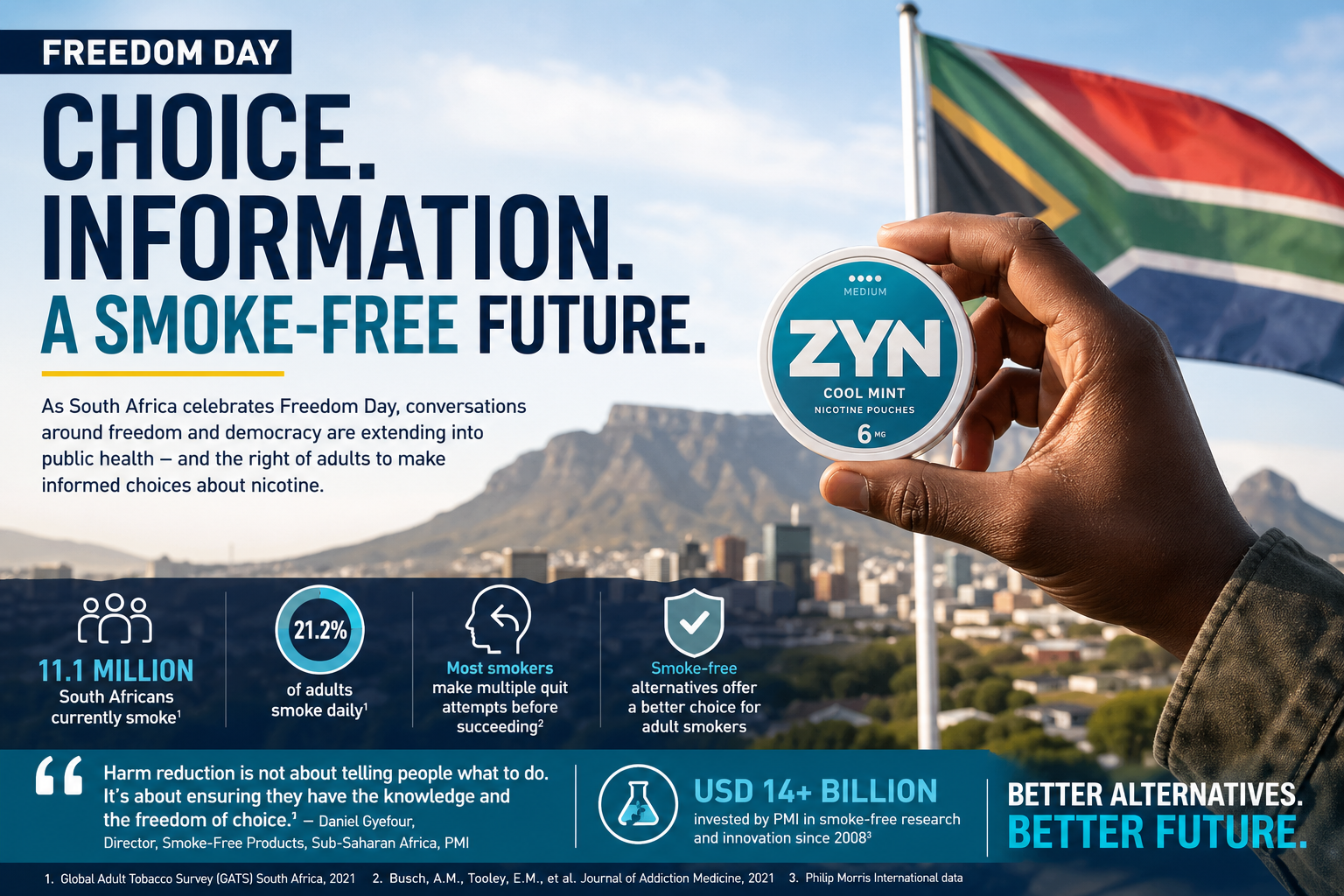
As South Africa marks Freedom Day, the national reflection on democracy, dignity and personal agency is increasingly extending beyond politics and into public health. Long regarded as a symbol of the country’s transition from oppression to democracy, Freedom Day continues to serve as a reminder that freedom is not only political, but personal — shaped by access to information, the ability to make informed decisions, and the right to act in ways that support individual wellbeing.
That broader understanding of freedom is now influencing how South Africans engage with nicotine consumption, particularly as conversations shift toward informed adult choice and alternatives to cigarettes.
Smoking Rates Remain High Despite Public Health Efforts
While anti-smoking campaigns, regulation and tobacco control efforts have helped reduce smoking prevalence in many parts of the world, the total number of smokers globally remains significant. In South Africa, the challenge remains particularly urgent.
According to the 2021 Global Adult Tobacco Survey, 21.2% of South African adults smoke daily, while an additional 4.6% smoke occasionally. This places the number of smokers in the country at approximately 11.1 million, highlighting the continued scale of tobacco use despite years of public health intervention.
Although many smokers express a desire to quit, long-term cessation remains difficult. Studies show that most smokers make multiple attempts before quitting successfully, with many relapsing within weeks or months. This has created space for a broader conversation around complementary harm reduction strategies for adults who are not yet ready to stop nicotine use entirely.
Informed Choice Becomes Central to Harm Reduction
As the global conversation around nicotine evolves, one question is becoming increasingly central: should adult consumers have the freedom to make their own informed choices about nicotine consumption?
Daniel Gyefour, Director of Smoke-Free Products for Sub-Saharan Africa at Philip Morris International, says the shift reflects more than changing consumer habits.
“This signals a profound cultural and behavioural change that reflects not just stronger public health policy, but a meaningful transformation in how people think about their wellbeing,” says Gyefour.
The shift, he argues, is less about replacing one habit with another and more about acknowledging the realities of consumer behaviour — particularly among adult smokers who would otherwise continue smoking.
Smoke-Free Alternatives Gain Ground
For adult nicotine users who are not ready to quit entirely, smoke-free nicotine alternatives are emerging as a growing part of the public health conversation. These products are designed to reduce exposure to the harmful effects associated with combustion-based tobacco, while still allowing adult consumers to exercise personal choice.
Among these alternatives is ZYN, a nicotine oral pouch developed by Philip Morris International as part of its broader smoke-free strategy. Designed for adult nicotine users, ZYN delivers nicotine without smoke, ash or the disruption of traditional cigarette use, positioning itself as a discreet and modern alternative for consumers seeking reduced-harm options.
“Adult smokers are looking for options that fit their lifestyles and preferences, especially alternatives that do not rely on combustion,” Gyefour says. “We are committed to providing alternatives that empower adult consumers to make informed decisions. Harm reduction is not about telling people what to do. It’s about ensuring they have the knowledge and the freedom of choice.”
Freedom, Choice and the Future of Nicotine Consumption
As South Africa continues to define what freedom means in a modern democracy, the conversation is increasingly moving toward how informed choice applies across every part of daily life — including health.
For companies like Philip Morris International, that means positioning harm reduction as a matter of consumer empowerment rather than restriction. The company says it has invested more than $14 billion globally in smoke-free research and innovation since 2008, with plans to continue expanding alternatives for adult smokers over the next five years.
The broader message is clear: as South Africa reflects on freedom, the future of public health may increasingly depend not only on regulation, but on ensuring adult consumers have access to better information, better alternatives and the ability to make informed choices for themselves.